Title - Ben Bernanke's Fed
Year - 2008
Author - Ethan S, Harris
Review (2010)
Sampson I.M Onwuka
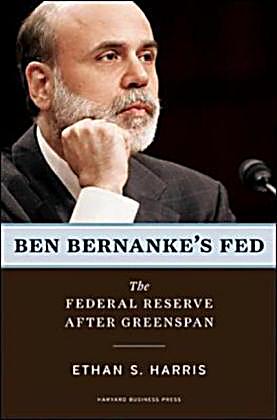
Ethan Harris in his book ‘Ben Bernanke’s FED; The Federal Reserve After’ (2008) did not particularly demonstrate this idea of CPI index which is central in deciding the actions of Federal Reserve under Greenspan. Although the author is praised to documenting some of the shortfalls in the Feds attitude to rates leading to the question of the economic bubble bursting, he did not identity the chief of the bubble in the first place, and did not lead us into other arguments about the future of Fed's practice in United States and perhaps elsewhere. The Core issue a factor in Federal Reserve tool for handling inflation would have served the author a more pronounced and prescient praise for his foresight on housing. It is natural to throw some weight on the excuse that the book was perhaps written at the time when the problems of 2008 was still evolving, it matters that the history of the times of Federal Reserve - similar to some degree but not different from Allan Mertz 'History of the Feds' approaches the Chairmanship of Bernanke from the canopy of Greenspan.
Our view of the approach to his book will center on the nerve that connects the two Fed Chairmen, emphasizing the limits of expectations in the later and turbulent years of the longer regnant administrator of the Federal Reserve - Alan Greenspan - with background in carpet industries and commodities, to a Professor with academic background and a bench-wall performance at the colossal issue of depression during the 20's and 30's. That experts consider the WWII as instrumental in driving in the transformations of F.D.R is reliquary of the arguments made over the years by Bernanke. The margins of separations between both hang time characters arrive at different tread lane in the hall of the famers for reigning over-heat market (Greenspan) and driving a peg through a divided house - which both icons so speak share. The limiting fractions of performance rate of the daily markets and cyclical momentum to rate of money is perhaps blind argument for terms rate and the poor problems of OCD on one hand and OTC on the other. If OTC - over the counter trade was reaching an unhealthy proportion at the eve/s of the collapse of Lehman and Bear Stearns, the peg will arrive somewhere - perhaps a reverting to day time buying and lack of confidence in small business administration under Greenspan to whole downsizing of the several arteries of Banks eventually considered 'too big to fail'.
There are material reasons why either of the two houses bloomed and dissolve differently, especially the clause forbidding lending practice as ameliorated in 13(13), and the precinct once considered sacrosanct were in the decade of Bernanke and his group - including like thinker such as Henry Paulson breached with reasons. It is eagerness perhaps to draw conclusions that the Bernanke's Fed resumes a title with a future - that this future contrary to what happened in the years of Greenspan was tempted to look a stone image different from the predecessor. The main button to press is the drama unfolding in the years leading to Bernanke - especially the hot button pressure that Bernanke piled on default rate in 2000. This could have been a reason why the house divided in the favor of Bernanke but there are other concerns that a pluck from the purely academic field - whatever that meant - represented a shift to a forward with redeeming shadow of the 80's and the 90's and parts of 2000. If the appointment was not the official reason to reign in the next President, there are hardly any information to dodge the demands for new direction following the arrival of Europe and the rise of China looking to make a presence known in the world. The more general issue regarding the cost of houses and the irrational exuberance of the so called 2000 were still hot button issue for U.S economy encouraged growth of its small business administers.
Some of the more standing reasons why Bernanke preferred Big banks is no where confined to his earlier years at Princeton, but seems to have stemmed from over-trunk of his character and foresight than the implosion of London big engagement as from Universal Banking. We cannot for the book by Ethan Harris separate the demand curve isolating small and retail and irrational conspicuous behavior of Greenspan to Bernanke on any hunch whatsoever saving the final pages of 2008 where the houses caved in from endogenous strain than the normal bias of exogenous. It is the character of Bernanke to Greenspan than distil part of the disguise over the dodgy issue of VAR, which Bernanke is not item, but for a fact that inflation and experiment was a prone to call in his years at the Feds yield to the cross fire with Greenspan that small growth and small business were necessary and formed a backdrop to America in spite of the later years.
Perhaps the tedium that the CPI reflected investor attitude as the textbooks lead, play opposite from the shadow of a professor to the alter of the professor with intellectual athleticism huddling to a final end which came in 2008. A sharp contrast on this persons of interest define the two polar end of the same coin, and leads to some distinction between the end of an era and the beginning of a new. We can score the journalistic impression of finance magnet - Ethan Harris, and his quality hardly suffer for reasons of its clarity, but there are questions about the temerity of enclosure regarding the expectation of a Bernanke in office. From such vintage - even rear-view, there are hardly any scorching in the demand for direction of world markets and economy - that unbeknownst to the rest of the world America in the 90's was the very epicenter of world markets. The uncertainty of the next decade proved a course too much to even consider a Fed's problem - that as with Yellen - the current Chairperson of the Feds, the central role of economic transformation was merely and ultimately the decision complex of the government, a case in bayou that Bernanke hinted for in cameo of short batten and exchange from small and many banks to big banks. An ideal argument may lead us to consider the role of Big banks as evocative of credit health of any economy in plus or positive markets, but there are question of alternative which these Big banks induced and at best - they raise then and perhaps in future the problems of pensions parceled as debt in the game of mergers and acquisition and in ability to harness stress and strain which many banks can bear than big banks and their large earnings rate tied mainly oversea due to compulsive tier 3 lending and Basel II.
There is no doubt that he alluded but the very nature or importance of the CPI index in understanding the formation of crisis and targeting inflation was not taken serious or articulated well. It may be due to the school that the author represented and the influences over the years, since he used other indicators such that the lag indicators to make some point clear about the CPI measurement. He mentioned quoted Bernanke saying “Deflation is in almost all cases a side effect of a collapse of aggregate demand – a drop in spending so severe that producers must continually cut prices in order to find buyers. Likewise, the economic effects of a deflationary episode are, for the most part, similar to those of any other sharp decline in aggregate spending – namely, recession, rising unemployment, and financial stress”
Ethan Harris, (p.96), mentioned “unfortunately, the money
growth targets were generally a failure. The problem was that financial
innovation blurred the line between money (liquid assets such as cash and
checking accounts) and illiquid savings. For example, an interest paying money
market fund is a lot like a checking account but it is also a very safe form of
saving. If money market funds are growing rapidly, does this mean there is a
lot of money or liquidity in the economy, facilitating spending and suggesting
inflation risks? Or is it a sign that investors are seeking safe investments
suggesting a weak spending climate and low inflation? Ethan Harris continued
that “Until the early 1980’s statistical tests showed that surges in money
growth were followed – with a one or two year lag – by surges in nominal GDP
growth.
By contrast, in the last twenty-five years or so, strong money growth has been associated – with a lag – with slower GDP growth. Ironically, just as the money targets were being adopted, the relationship between money growth and the economy became very unstable. As Gerald Bouey, former governor of the Bank of Canada put it “we did not abandon the monetary aggregates, they abandoned us.”
While these facts seem to indicate that a change was necessary in indicating the right measurement for inflation or the rate of inflation based on aggregate – Keynesian Monetary Aggregate - we may be shifting towards an era where spending is so sophisticated that actual spending if they ever meet expectations are within are within the inflationary pressure and may not easily or necessarily apply to money supply, such that inflation targeting may be reduced to more flexible economic indicators.
By contrast, in the last twenty-five years or so, strong money growth has been associated – with a lag – with slower GDP growth. Ironically, just as the money targets were being adopted, the relationship between money growth and the economy became very unstable. As Gerald Bouey, former governor of the Bank of Canada put it “we did not abandon the monetary aggregates, they abandoned us.”
While these facts seem to indicate that a change was necessary in indicating the right measurement for inflation or the rate of inflation based on aggregate – Keynesian Monetary Aggregate - we may be shifting towards an era where spending is so sophisticated that actual spending if they ever meet expectations are within are within the inflationary pressure and may not easily or necessarily apply to money supply, such that inflation targeting may be reduced to more flexible economic indicators.
The author went on to indicate that the US open market committee may be jeering towards OLIR – Optimal Long-Run Inflation Rate and MCIR – Mandate Consistent Inflation Rate, the initial plus argument on monetary aggregate is that kowtows PCE Deflator and the incident of new and serious breakthrough in other business of money and bank development fosters CPI inflation, all of which are forms of targeting, due perhaps to a certain era, but ultimately about countering inflation however in the Long term.
Ethan Harris also indicated that the work of George Akerlof
and Joseph Stiglitz which “showed that frictions in the credit market are
important in understanding the linkages between financial markets and the real
economy.” That example “of such of frictions include imperfect information.
Joseph E Stiglitz in his 'Free Falling’, stated however that ‘Those who focused
single-mindedly on inflation (The Chicago School and rigid money wage
Keynesians) were right that because with inflation, all prices do not change
simultaneously".
By prices he necessary meant interest rate. We point that a case in point is Europe trying to provide a better estimate of ECB and member states attitude towards when the key members are reacting to their interest rate simultaneously and what happens perhaps after. A comparison between these ECB Banks and American Fed Reserve may not settled in LIBOR or in overnight lending, or through Chicago overnight policy, or through the ability of one institution to hold their breath when it counts than the reasserting the basic essence of a Central Bank. In the end, there are few lefts and rights about the future a Federal Reserve which requires the calculated charisma of the whole school, number hundreds with burn-in graphs showing limits of cyclical trends.
A history which the author highlighted on motions for a lack of depression for over half a century, can in itself transform into a second argument that M1 and M2 theories proved a backdrop to the Federal Reserve than the issue of credit card and risk assessment in onus of the struggles of Europe countries in 2008.
The simultaneity of changes in inflation may have worked for the bond market, and may have worked with due respect to Keynes and his multiplier effects but cannot apply to money and stock market in current time.
By prices he necessary meant interest rate. We point that a case in point is Europe trying to provide a better estimate of ECB and member states attitude towards when the key members are reacting to their interest rate simultaneously and what happens perhaps after. A comparison between these ECB Banks and American Fed Reserve may not settled in LIBOR or in overnight lending, or through Chicago overnight policy, or through the ability of one institution to hold their breath when it counts than the reasserting the basic essence of a Central Bank. In the end, there are few lefts and rights about the future a Federal Reserve which requires the calculated charisma of the whole school, number hundreds with burn-in graphs showing limits of cyclical trends.
A history which the author highlighted on motions for a lack of depression for over half a century, can in itself transform into a second argument that M1 and M2 theories proved a backdrop to the Federal Reserve than the issue of credit card and risk assessment in onus of the struggles of Europe countries in 2008.
The simultaneity of changes in inflation may have worked for the bond market, and may have worked with due respect to Keynes and his multiplier effects but cannot apply to money and stock market in current time.

No comments:
Post a Comment