Thursday, October 29, 2015

Timothy Geither 'Stress Test'


Title - Stress Test

Author - Timothy Geithner - All Reserved.

Year - 2014

Publisher - Crown Publishing

Review - by

Iroabuchi S. Onwuka


To whom it concerns,

The book by Timothy F. Geither - Stress Test - is a New York Times, Washington Post, Los Angeles Times - best seller list. Not that the book deserves the average 3.8 stars for a Geithner 'reflections on financial crises' for 2008. There are obvious departures in the books, with emphasis on the decision he had to make as the Chairman of New York Federal Reserve (2003 - 2009) and consequently the Secretary for U.S Treasury (2009 - 2013). A stress test for banks is not a new item but in 2008 crises it was introduced by Bernanke, Paulson and Geithner. The aim was to determine the banks readiness in handling crises or shocks to the system especially based on the experiences with Lehman Brothers and other Investment banks. The exercise with financial instrument ended the careers of many small banks in the United States including banks considered too fail.

The main compenent of the stress test was a bank's ability to function without the extensive support of the Central Bank or Federal Reserve. New requirements for these banks with down time on OCDs, with extensive exposure to International market including 'cuffing out' (Geithner) for the Federal Reserve.


Some of the reserve requirement was the low to zero interest rate and funds rate at very historic lows. One of the problems of the stress test whcih did not meet Basel II Standards was the very failure of these financial engineers to broadly define the limits of its implication. For a long time, the general public - poor with financial literacy simply did not understand the various methods resolved by Paulson - who was on his way out, Bernanke - who was partly experimenting with zero interest, and Geithner - dubbed the last pope of the 2008 class. The lessons are found elsewhere that Geithner - in this book - failed to some extent to define the stress test and how reflections on 2008 amount to a test. Perhaps we can recall that the interest we deserve can be honed through Geithner's thesis on the need to forestall a second financial crisis. On purely academic bench, an attempt to forestall a second crises is a lasting impression of the most logical step following periods of financial failures.

An account of the financial failures in 2008 of the widely read 'Financial Crisis' concerning the formation of crisis was a good job in bad suits or 'so-so' job in clean suits. The same cannot be said of Geithner's 'Stress test' largely for the fact that some of us have followed his career for sometime. The morose introspection that the book conjures for others may lack any meaning for anyone half familiar with the events of 2008 or with the Geithner's banking carion. It is important to make the argument clear that writing 6 years after an incident personally vouchsafed for suffer in quality and pale in amelioration to other genres written a few later. In a sense, the collective dispatch in Alan Blinder's 'When the Music Stopped' is official gravitas for gaps in 'Stress test'. A stress test involves measures that test the background of many institutions under the canopy of Federal Reserve and why they relate to the need to compare financial markets to U.S local derivative, especially the rise of ETF and problems of OTC which buried many investors.

Geithner's story about the 2008 incident is not new or many people impressed by the detailing of the crisis. We were interested in how the stress test of Banks during this period and after proclaimed a new banking order for U.S, especially the concern for making sure there are no repeats. We are interested in how U.S banks were doing over the same period with respect to other banks around the world, and why it was necessary that certain banks had to go following their official statement. We are concerned with periodic timetable for stress test for banks and the issue of economic drift or shift during periods of surplus and how these surplus renade the low interest rate and duration for banks to make necessary changes. We are concerned with other issues of policies which the events of 2008 did not cover or counter, especially the investment and re-investment acts prescribed in Federal Reserve requirement.

We are interested in the last minute measures of 13 (13) policies and why it remained anathema and virtually unknown until the eve of certain investment banks. We have a shadow on knowledge on the various books which details their testimonies about the period and therefore hoped that one of the chief mouthpiece can amend such of the assumptions. All these are expectations that begins to explain the mindset of an averga reader. These were not treated and were hardly a cornerstone in the book. I, for one, see interesting academic asserting and inteligent work which can only come through a Geithner with huanted experience preceding the events locale of 2008.


In reassuring look at the very title 'Stress test' upon his reflections, the title send you on an errand. In an end, we come out wondering why some of the concerns of Geithner were not taken into measure ab-initio, and why it was in rearview a coat for policy. Yet in all, one of the most enduring memories of Timothy Geithner which we need to torch on is the resolution of world markets, that is, he may or may not noticed that identifying in one his speeches why 'markets collides' proved a reason to restore the confidence of dollar and the faith in General Motors. General Motors and General Steel proved one of Obama's daring and deciding leadership instinct, but it was Geither's speech that called the market in 2009.     


There are lessons for a BRIC nation and there are elements of real estate which the new poerhouses made possible in U.S and perhaps elsewhere. The book for this reason is not exactly an ear-ful, is lack luster from the images of Henry Paulson 'On the Brink', is between a thoroughgoing Alan Blinder, and is a shoulder or perhaps more ahead of Andrew Sorkin's 'Too Big to fail'. Too big too fail proved a fitting title for a diary draft of unusual financial period dogged by forced not related study of money or real estate.


Ben Bernanke and Timothy Geithner.


Short View

(II)

We may not take the credit given the opinions of Timothy Geithner (2014) in discussing the impact of BRIC away from ECB, and how BRIC nation such as Russia drove Brazil economy in 1998 into economic recession. We tie the knots that the inseparable economic connection between Russia, Ukraine, Brazil, and Turkey, and the command of ‘collaterized debt obligations’ and ‘asset-backed commercial paper’ may foster hints of economic stress and conditions of neglect which become apparent in the IMF’s warning. The short terms stress test from combined reasons in the book rest easy on borrowing attitude and practical damage of oversight.


Although A joint committee between Federal Reserve, the Federal Deposit Insurance Corporation, Office of the Comptroller of the Currencies (OCC), the Office of Thrift Supervision, may enhance the weight on a stress test, we can add that manufacturing is not the same as production and is not small misplacement of credit and the role of international banks. The initially position of the manufacturer or manufacturer index could indicate its origins by the levels of free trade between separate Nations of interest and perhaps nothing else. It is a focus on this particular point in solution of interest rate and quantity of money – which I for one – can fully maintain are not related, that the quality intrinsic value without or not portentous lack the definite structure for inflation and market resources.

 
I look for a gap between ECB and member states banks in playing my cards on stress test, and I look for an inverse and reverse role play between the central banks and bigger and sensitive ECB in coming to grips with a banks' return rate. Based on some of the assumptions between IMF and fund's rate determined by crude oil, the saturation of banks and the new account deposits are effective litmust test on what is going on with a bank. When we compare half of the actions taken by U.S on any given influence in the last few years leading to 2008 or thereafter, it becomes certain that the circumstances surrounding the gap/s of information between the Federal Reserve or other interested group and any banks for deposit in U.S, explains why the actions by Bernanke and Paulson, epecially Bernanke and Geithner proved reactionary and forced in spite of its sucess in 2008. Some of the means od determining the death trap of these banks rest easy on the return rate of businesses, on the performance of small banks and diffusion rate of major Central Banks to national GDP - where fund’s rate with or without a decoupling with crude oil or other major products is proved not the case. 


But the VAR is easily discounted given Real Housing similar to cushion as Precious metals, but the differences especially for instance a VAR misaligned categories of convertible arbitrage and the Banks that create money through loans and mortgage, you may need the GSE; Fannie Mae, Sallie, and MBS to show relative proof that the banks sending under some degree of operational management make argument about importance of Bank policies which exist for instance when there is recall a recall of exposure, generated through a TARF basic coverage which depended on long term lending rates between two parties and generally obfuscate term facilities in lending which a hamster to Banks and their overnight lending. 


At least from the point of concession of foreign dominator to US Banks and/or ETF basics to US investment from both private and institutional money houses heading elsewhere (Third Tier markets in International or Third World economies, or government covered external Bonds whose major returns are through the exchange prairie and the guarantee of currency depression in spite of the in-money cover) or returning from foreign lateral (currency rotation).


It makes it impossible to discriminate between the operational lending of Investment side of the Banks and the Commercial side of the same Banks which some believe guarantees some levels of profit delivered through the composite available to deep resources of the Banks and index which transits to gains and further estimate of debt to earn and hence a bottom-line, either through the arbitrage or through existing or pre-existing banks stocks, whereas debt recovery becomes a restive case for Federal Cartels like the Reserve to force an adjustment to stability through M1 and M2, particular M2 liquid stated money injections.


Apparently, an argument – which I for one – cannot wholly take credit is about arriving at a point on a given momentum where the financial actions of ECB and collateral behavior in separating the fund rates to central banks of member states without combined expectation of lending to individual banks, at a lower rate than the ECB. It will be a form of role reversal, to a point that a role reversal, creates reasonably expectations gap behaviorally separating the performances of a World Bank or IMF and that of Federal or in this ECB, from the actions of the Central Banks like we have in specific economic societies.

 
Quantity is an influence on why products have value and why some don’t, but at no point does it prove a recipe or formula for inflation saving for the attitude of the market place and the expectations of the traders. If a Federal Reserve such as Australia and Central Bank such as England, could master the limits of expectations between major banks in a system dynamic – big banks etcetera - and the role of a central and larger font of last lenders, perhaps – at least in my view – we may come to grasp with versions of Bernanke’s motivation for Big Banks.


For Emily

Friday, October 23, 2015

John A. Garraty (1986)


Title - The Great Depression

Year - 1986

Author - John A. Garraty (1986) ‘


Review 

By

Sampson I.M Onwuka


John A. Garraty (1986) ‘

John A. Garraty (1986) ‘The Great Depression’ and rise of America was not because of Austerity measures the rise of America and their surpassing of Britain, was due to Britain’s relapse into degrees of Austerity measures book Market and Men (1936), by J. W. F Rowe “Sudden and widespread substitution of conscious artificial control for the unconscious control of a laissez-faire system”, which Garraty defended and ameliorated his position in his book to a different light, but the central issue is the great debate about Laissez faire vs. Deliberate Government spending, as similar to the….a commentator in International Labor Review market, that ‘The Fundamental issue is not, as is sometimes still supposed, between economic planning and laissez-faire.  

That question was decided in the years following the collapse of 1929. For good or ill, Government is already exercising and must continue to exercise an active influence in economic affairs.” When we look at themes from this era such as the teachings of President Herbert Hoover who mentioned in his political campaign that ‘THE DEPRESSION WAS NOT STARTED IN THE UNITED STATES’ that it came from Europe he brought to end the speculations for America for Americans, that “The Hurricane that swept our shore was of European origin”, that it was caused by the 1914 – 1918 impact of the WW I and the failure of Europe to make changes in the society.

But as A. Garraty mentioned, President Hoover couldn’t use the above line anymore as the condition got worse in USA. The temptation of seeing economic cycle as ‘essentially self-generating’ pervaded the economic reasoning at this point, the ‘leisure class’ of Veblen Thorsten reasoned along the decision complex of economic cycles, where it was gradually common that ‘good times in economy often portends bad times’ , that hard times usually create depression and depression has the grains of recovery.

This is the basic reason and sometimes undying principle of all economics that we should be able to store the dividend of good years in such a way that will shore for later years. Others mentioned that it is strategic investment at the ‘up’ years when there is booming and profit that gives the country a chance at survival when the boom is over.

This thinking was common in Europe especially among the Austrian School of economics until the coming the Great Depression and the introduction of momentum based economics which required a levitating of demand or aggregate-demand theory of John Keynes who argued against the normal cyclical market.

One of the Primus Inter alia of all US economic environment and market is Irving Fischer who looks to the possibility of stimulating growth through demand as a way to grow the economy, was essentially a case that Keynes made for anti-cyclical economy that lampooned laissez economic theory.

An economic growth can be made possible through effective planning which involves meeting and exceeding the economic balance sheet of most economies in the World that some years which are said to be better than others are theories that effectively strangulated some of the basic actions that could have saved the depression, in many ways than one, it was a matter of how well any society could effectively generate new investment and growth from what was essentially a problem of structure.

In U.S, people began to believe that the progress made by stock market in 20’s was a period of great leaps, that there were no changes at this period done to the structures in U.S, that American structure in these age leading to jump in the great economy was from an age America was not an empire, that when America got the attention that it wanted as blossomed into a super state, it was cultural backwards.

Tuesday, October 20, 2015

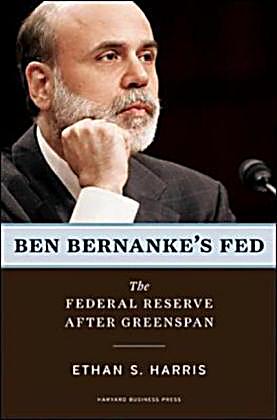
Ethan Harris 'Ben Bernanke's FED; The Federal Reserve After' (2008)


Title - Ben Bernanke's Fed
Year - 2008
Author - Ethan S, Harris


Review (2010)


Sampson I.M Onwuka


Ethan Harris in his book ‘Ben Bernanke’s FED; The Federal Reserve After’ (2008) did not particularly demonstrate this idea of CPI index which is central in deciding the actions of Federal Reserve under Greenspan. Although the author is praised to documenting some of the shortfalls in the Feds attitude to rates leading to the question of the economic bubble bursting, he did not identity the chief of the bubble in the first place, and did not lead us into other arguments about the future of Fed's practice in United States and perhaps elsewhere. The Core issue a factor in Federal Reserve tool for handling inflation would have served the author a more pronounced and prescient praise for his foresight on housing. It is natural to throw some weight on the excuse that the book was perhaps written at the time when the problems of 2008 was still evolving, it matters that the history of the times of Federal Reserve - similar to some degree but not different from Allan Mertz 'History of the Feds' approaches the Chairmanship of Bernanke from the canopy of Greenspan.


Our view of the approach to his book will center on the nerve that connects the two Fed Chairmen, emphasizing the limits of expectations in the later and turbulent years of the longer regnant administrator of the Federal Reserve - Alan Greenspan - with background in carpet industries and commodities, to a Professor with academic background and a bench-wall performance at the colossal issue of depression during the 20's and 30's. That experts consider the WWII as instrumental in driving in the transformations of F.D.R is reliquary of the arguments made over the years by Bernanke. The margins of separations between both hang time characters arrive at different tread lane in the hall of the famers for reigning over-heat market (Greenspan) and driving a peg through a divided house - which both icons so speak share. The limiting fractions of performance rate of the daily markets and cyclical momentum to rate of money is perhaps blind argument for terms rate and the poor problems of OCD on one hand and OTC on the other. If OTC - over the counter trade was reaching an unhealthy proportion at the eve/s of the collapse of Lehman and Bear Stearns, the peg will arrive somewhere - perhaps a reverting to day time buying and lack of confidence in small business administration under Greenspan to whole downsizing of the several arteries of Banks eventually considered 'too big to fail'.


There are material reasons why either of the two houses bloomed and dissolve differently, especially the clause forbidding lending practice as ameliorated in 13(13), and the precinct once considered sacrosanct were in the decade of Bernanke and his group - including like thinker such as Henry Paulson breached with reasons. It is eagerness perhaps to draw conclusions that the Bernanke's Fed resumes a title with a future - that this future contrary to what happened in the years of Greenspan was tempted to look a stone image different from the predecessor. The main button to press is the drama unfolding in the years leading to Bernanke - especially the hot button pressure that Bernanke piled on default rate in 2000. This could have been a reason why the house divided in the favor of Bernanke but there are other concerns that a pluck from the purely academic field - whatever that meant - represented a shift to a forward with redeeming shadow of the 80's and the 90's and parts of 2000. If the appointment was not the official reason to reign in the next President, there are hardly any information to dodge the demands for new direction following the arrival of Europe and the rise of China looking to make a presence known in the world. The more general issue regarding the cost of houses and the irrational exuberance of the so called 2000 were still hot button issue for U.S economy encouraged growth of its small business administers.


Some of the more standing reasons why Bernanke preferred Big banks is no where confined to his earlier years at Princeton, but seems to have stemmed from over-trunk of his character and foresight than the implosion of London big engagement as from Universal Banking. We cannot for the book by Ethan Harris separate the demand curve isolating small and retail and irrational conspicuous behavior of Greenspan to Bernanke on any hunch whatsoever saving the final pages of 2008 where the houses caved in from endogenous strain than the normal bias of exogenous. It is the character of Bernanke to Greenspan than distil part of the disguise over the dodgy issue of VAR, which Bernanke is not item, but for a fact that inflation and experiment was a prone to call in his years at the Feds yield to the cross fire with Greenspan that small growth and small business were necessary and formed a backdrop to America in spite of the later years.


Perhaps the tedium that the CPI reflected investor attitude as the textbooks lead, play opposite from the shadow of a professor to the alter of the professor with intellectual athleticism huddling to a final end which came in 2008. A sharp contrast on this persons of interest define the two polar end of the same coin, and leads to some distinction between the end of an era and the beginning of a new. We can score the journalistic impression of finance magnet - Ethan Harris, and his quality hardly suffer for reasons of its clarity, but there are questions about the temerity of enclosure regarding the expectation of a Bernanke in office. From such vintage - even rear-view, there are hardly any scorching in the demand for direction of world markets and economy - that unbeknownst to the rest of the world America in the 90's was the very epicenter of world markets. The uncertainty of the next decade proved a course too much to even consider a Fed's problem - that as with Yellen - the current Chairperson of the Feds, the central role of economic transformation was merely and ultimately the decision complex of the government, a case in bayou that Bernanke hinted for in cameo of short batten and exchange from small and many banks to big banks. An ideal argument may lead us to consider the role of Big banks as evocative of credit health of any economy in plus or positive markets, but there are question of alternative which these Big banks induced and at best - they raise then and perhaps in future the problems of pensions parceled as debt in the game of mergers and acquisition and in ability to harness stress and strain which many banks can bear than big banks and their large earnings rate tied mainly oversea due to compulsive tier 3 lending and Basel II.


There is no doubt that he alluded but the very nature or importance of the CPI index in understanding the formation of crisis and targeting inflation was not taken serious or articulated well. It may be due to the school that the author represented and the influences over the years, since he used other indicators such that the lag indicators to make some point clear about the CPI measurement. He mentioned quoted Bernanke saying “Deflation is in almost all cases a side effect of a collapse of aggregate demand – a drop in spending so severe that producers must continually cut prices in order to find buyers. Likewise, the economic effects of a deflationary episode are, for the most part, similar to those of any other sharp decline in aggregate spending – namely, recession, rising unemployment, and financial stress”


Ethan Harris, (p.96), mentioned “unfortunately, the money growth targets were generally a failure. The problem was that financial innovation blurred the line between money (liquid assets such as cash and checking accounts) and illiquid savings. For example, an interest paying money market fund is a lot like a checking account but it is also a very safe form of saving. If money market funds are growing rapidly, does this mean there is a lot of money or liquidity in the economy, facilitating spending and suggesting inflation risks? Or is it a sign that investors are seeking safe investments suggesting a weak spending climate and low inflation? Ethan Harris continued that “Until the early 1980’s statistical tests showed that surges in money growth were followed – with a one or two year lag – by surges in nominal GDP growth.


By contrast, in the last twenty-five years or so, strong money growth has been associated – with a lag – with slower GDP growth. Ironically, just as the money targets were being adopted, the relationship between money growth and the economy became very unstable. As Gerald Bouey, former governor of the Bank of Canada put it “we did not abandon the monetary aggregates, they abandoned us.”


While these facts seem to indicate that a change was necessary in indicating the right measurement for inflation or the rate of inflation based on aggregate – Keynesian Monetary Aggregate - we may be shifting towards an era where spending is so sophisticated that actual spending if they ever meet expectations are within are within the inflationary pressure and may not easily or necessarily apply to money supply, such that inflation targeting may be reduced to more flexible economic indicators.


The author went on to indicate that the US open market committee may be jeering towards OLIR – Optimal Long-Run Inflation Rate and MCIR – Mandate Consistent Inflation Rate, the initial plus argument on monetary aggregate is that kowtows PCE Deflator and the incident of new and serious breakthrough in other business of money and bank development fosters CPI inflation, all of which are forms of targeting, due perhaps to a certain era, but ultimately about countering inflation however in the Long term.


Ethan Harris also indicated that the work of George Akerlof and Joseph Stiglitz which “showed that frictions in the credit market are important in understanding the linkages between financial markets and the real economy.” That example “of such of frictions include imperfect information. Joseph E Stiglitz in his 'Free Falling’, stated however that ‘Those who focused single-mindedly on inflation (The Chicago School and rigid money wage Keynesians) were right that because with inflation, all prices do not change simultaneously".


By prices he necessary meant interest rate. We point that a case in point is Europe trying to provide a better estimate of ECB and member states attitude towards when the key members are reacting to their interest rate simultaneously and what happens perhaps after. A comparison between these ECB Banks and American Fed Reserve may not settled in LIBOR or in overnight lending, or through Chicago overnight policy, or through the ability of one institution to hold their breath when it counts than the reasserting the basic essence of a Central Bank. In the end, there are few lefts and rights about the future a Federal Reserve which requires the calculated charisma of the whole school, number hundreds with burn-in graphs showing limits of cyclical trends.


A history which the author highlighted on motions for a lack of depression for over half a century, can in itself transform into a second argument that M1 and M2 theories proved a backdrop to the Federal Reserve than the issue of credit card and risk assessment in onus of the struggles of Europe countries in 2008.


The simultaneity of changes in inflation may have worked for the bond market, and may have worked with due respect to Keynes and his multiplier effects but cannot apply to money and stock market in current time.


Sebastian Mallaby - 'More Money than God; Hedge Fund and the making of a New Elite’


Title - More Money than God
Year - 2010


Author - Sebastian Mallaby


Review

By

Sampson I.M Onwuka


Sebastian Mallaby in a recent book ‘More Money than God; Hedge Fund and the making of a New Elite’ attempted to show that a correlation exist between mega booms and then burst and rise of Hedge Fund managers.


Although the title of his book is a hyperbole, he managed to mention that the frenetic rise of Hedge Fund management and risk taking in the world of business is such that poor restriction and rise of super computers, may have added new face to stock market.


Nowadays, Rating is so cornered by major corporations and Banks that the indexes that gave birth to some of the healthy assumptions of the SEC may now have eroded.


The list of the new champions in Global Hedge Funds may include David Swensen, Jim Simmons, David Show, Tom Steyers, but these men are hardly known in any era of business or the impact of their daily business of any significance.


Mallaby highlighted the observation by some of the great in the business, such as Rubin who mentioned in 1983 that Wall Street has changed completely. The author mentioned that “As leverage multiplied investor’s buying power, the sheer size of the bond market had been transformed. In 1981, according to securities Data, new public issues of bonds and notes (Excluding Treasury Securities) totaled $96 billion”, the author noted that by 1993, those offerings had ‘multiplied thirteen-fold to 1.27 trillion’.


Sebastian Mallaby also stated that “The Fed could have chosen to redefine its inflation – fighting mandate. It had traditional set interest with a view to keeping consumer prices stable. But the question(s) raised by bond market collapse of 1994 concerned the stability of asset prices.”


Mallaby went on to ask that “If the bond market heads into record territory, as it had in 1993, shouldn’t this be taken as a signal that credit is too cheap – and that it is time to raise interest rates in order to deflate a bubble? Because the Fed had been in targeting inflation rather than the bond market, it had allowed the bubble to expand.”


This is no doubt a classic case of Frederick August Hayek, on the why the Great Depression 1929 through 1932, lasted that long in America, a case of cheap financing over a long period of time which made the case quite easily for value of the existing market to essentially collapse.


Although the lack of statistical arbitrage and the English removal of pounds sterling from Gold, may have also contributed to the International Valuation, it ultimately.


Why Mallaby is following the footsteps of Friedman and to some degree Hayek, we may say that this most important portion of his book, seen to be wrong or in fact flawed. The major difference between emphases on targeting inflation and bond market is that much of CPI as resulted from inflationary pressure, which is Frisson for market, hence lenient to stock, provides beta-data for general consumption, first by way of Bond that seldom performs higher than stocks, and by other factors that establish the spot rate in any market.


Such case is opposed to more active data – subject to very intense curare which the stock and not the bond can provide. But the possibilities have always been there, especially before the incident of 1959, where Bonds outperformed stocks, proving that Bond could literally outperform stock.


That bonds outperform stock is not impossible, for instance various in the money calls, involves some faith of what is happening to stock, where institutional traders navigate between a resistance area of the stock, government policy and other measures to trade in the bond.


This one the instant that seem in many ways relevant to market conditions in Europe. If European countries such as Greece and Portugal had continued this act of padding additional debt, the debts might accrue or compound over time, such that ratings will be affected and therefore Junk for Greece will attract additional money from foreign and as well local investors.


The result will be much emphasis on bond as opposed to stock on the bait that if it goes wrong, Greek Government or even ECB will come to their rescue – however expensive. So this is called positive economist, one of the mean rate advantage or neutral.


The solution would lie in excusing the cancerous member from the community – albeit temporarily. Of course the generality of the problem refers to the independent assortment of community members, especially their area of strength or weakness.


If for instance Greek is not doing that good, we should pay attention to other European countries, rather to why as whole Europe is not doing that good. In terms of the attraction, we say that Euro/Dollar liquid terms may illustrate forward market, may explain too much current migration with a North stream strategy and therefore open all kinds of resets.


Convertible resets (?) would require a third partner such as Asia (or any Carry Trade) in respect to Euro-Dollars and in addition to Basel II or III capital requirement, which would need additional changes in capital or financial structure of the host countries.


One overhang case is what is happening between Ireland and ECB, where Ireland would have to reciprocate the Basel II and III, and of course Tier stories (I and II), in order to host an excursion of foreign labels or currency in loans and investment.


That may mean restructure of some of its Banks, yielding at least an 8% additional ground to Europe or whatever country of import. Such ‘covered call strategy’ is what Euro is primary good for, a classic case of positive economics, which however negates the problem of variance in shorts of long, when the mean variance is all but determined, hence a Call.

Friday, October 16, 2015

Steven Solomon ‘The Confidence Game’


Title - The Confidence Game

Author - Steven Solomon - All Reserved.

Review - Sampson I.M Onwuka

Year of 2005

The big is old and the emergent revisionist reason for Stephen Solomon is no where confined the problem of federal funds rate and the delay for new rates which are characteristically new emergent properties in world of money and the history of Federal Reserve and Central Bank system.


Steven Solomon writing in his ‘The Confidence Game’ demonstrated why the London ‘Big bang’ forced all kinds of public interest and proved a substantial problem for Mortgage as well as Insurance companies, in the 80’s. The 80’s were full of innovation, and not only innovation in terms of business done or owned by Americans, the 80’s was a time when International corporations and Banks, or what is now ‘super-safe’ companies, such as Freddie and Fannie, attracted the most exposure from Europe. The 80’s was a decade of great ‘mergers and acquisitions’ many of which was between European International countries benefiting from their 1978 agreement and their Banks to invest in the United States and International market as against the registration on U.S banks trading oversea. Although something can be said about the LIBOR preceding 1978 and even 1971, the role of International Banks in helping to sprout European Banks all over the States was mostly effective after 1978. 


This 1978 transformation was also not a handicap since the beginning of liberal International exposure of European Banks gradually ended  Breton Wood accords and the role of International Baskets. The real question is how these countries and their representative fared in time of crisis and why? The second question is why the exposure to European funds to U.S vice versa required a separ and other basic requirement of Basel I. From Steven Solomon we gave the idea that the exposure of foreign funds to international markets created the need for more careful observation and moratorium. At large it was not happening neither was the case of Universal Banking a careful incident amounting to something other con attitude. Above all he seem to indicate that the bait on CDO and bizarre, Credit Rating, consequent to what is now ‘Synthetic Securities’.

Steven Solomon attempted to suggest is that the ‘Confidence Game’ surrounded so to speak surrounded a certain Hedge Fund managers who took a plastic view of faulty triple A rating the elemental Ratings agencies when against the baiting or the real conditions of the market, was a careless risk. The trial of Universal Banking came therefore on October 1987, following the announcement that U.S will invade Kuwait. The question of losses so often the case with many International banks participating in one, forced new and additional light to be thrown on the question of monitory World financial society.  


No doubt that the foundation of what we might regard as European Union was based entirely on this view of Universal Banking. No doubt that the influence of Chicago Board of trade and exchange of cash without CME, may added to the attraction of European Banks to America, and may have further widened the gap between the American Banks who barred from dealing directly in securities and the Internationals who set their own financial products. The gap between Universal Banking and its interpretative position by way of Specialized Bank is gradually been breached and nothing like that theory which noted as the London ‘Big Bang’ of 1986, had the freedom to experience the trial and effort by the rest of the world.  That the theory began under Margaret Thatcher but tested by October 1987, the World Broad Market involves strategic investment from different parts of world into one continues chain of interrelationship via Exchange markets such as Euro Bond or other Cash Funds.

Short View


The London ‘Big Bang’ was the tendency to draw up International for Banks engaged in trans-border trade, and securities lending beyond the borders of their country (a given demand and supply) and as well engage in all kinds of Insurance Finance Product in the retail market. The issue covering this view began shortly after the 1978 agreement of European countries that their respective Banks can participate in US securities market. But the exact nature of their participation and degree of participation needed additional prescription, verse Europe. The call for monitoring activities of the Banks was raised by… and it amounted to Universal Banking, which also included the freedom to deal with business between the two days of the country. But after the incident of the 1987, London Banks were able to fully conduct the full range of securities business. All of these led to the whole notion or revival of ‘structural spectrum’ and higher emphasis on IMF as a form of Specialist Bank, where a newer Bank was in the pipes for making a serious difference.


Sunday, October 11, 2015

Henry Paulson (On the Brink)


for Henry Paulson (On the Brink) @ 2010 All Rights Reserved.

Book Review - Sampson I.M Onwuka


The crux of Henry Paulson's (2010) is the actions taken by the State and by the Treasury to helm the losses from Banking and other financial institution in 2008, especially the actions he took against Lehman Brothers and Bear Stear which forced their departure from Investment Banking. Lehman Brothers Long Term Government Bond Index (no-longer extant) was used by many trade or financial curates to guesstimate and explicate International Long bond, the LB. The relapse of several competing funds group, led to a form of competition (that was sometimes invented) and were better known by their perform grade developed in part by what of happening in many parts of the banking industries than the supposed saving. They call it Medium term ‘aggregate bond’ which as I have maintained, was solo to prevailing European financial environment, was for many years essential to fixed return with respect to savings which determined the participation of the financial institutions - especially(the Jay Cook and Guy Levy) style of Investment Banking for the long. But the global market was 'On the Brink' in 2006 and by 2008 the losses were serious economic consequences. It may be hard to argue that the global markets and the United States may or may not survived the balance sheet problems from this era, that the relapse into debt and failures to close the gaps was not perhaps overnight sensation.

The problems is the reaction of the man whose we read, it fail into the glove compartment of the Treasury Secretary - Henry Paulson who along with Bernanke and Geithner had to respond to the growing and recurrent problems with Investment Banks. It will cost a trillion dollar to helm some of the losses in Housing and the White House was not in the position to argue or was it expected to react saving through the role of FHFA and the continuing problems of persons of interest such as Jim Lockhart and investment banks considered then as well as now 'Too  Big to Fail'.

If we grant Paulson and his book the merits of 13 (13) initially used by Minsky in some  80's low growth, it defeats the pretension that either the Federal Reserve were drawing something from Treasury or that they saw the consequences of their actions as actions requiring legal foundation given over-stating persuasion of the actions as from their office. It merits here a statement that Henry Paulson did not incorporate the larger danger of default as a historical problem - that risk is both near and persuasive (historical) that the Market was a victim of the indolent efforts to control the price range or that Taylor's rules were essentially out of the question by the 2000 entering of ECB to world market. The fault of historical narrative places Bernnake inches away from the gap in Paulson book.  Bernanke once insisted that medium default rate was not very easy to gauge hence the book defines the reaction of the government and treasury to the collapse of housing markets. If this was primary to the problems of housing that caved in following a decade of hot money and over-priced real estate, it did not sell in the book Henry Paulson - On the Brink.

If the book mentioned the vast role of insurance companies in chugging some lapses in the financial collapse of 2008, the book would have scored with competency it would have scored differently following our understanding of the later days of George W. Bush as President.

During the issue of 2008, Richard Fuld wanted to transform Lehman from being a brokerage to an Investment Bank, a move that was part of the original idea of Universal Banking which the major brokerages and underwriters commercialized. Their business empire and industry was far reaching and consequential, to the degree that major brokerages in US had outlets in nearly everywhere in the world. Richard Fuld was therefore right-on in breaking into the area by asking Treasury and the Federal Reserve of New York, in the crass of the 2008 miscalculations and then exposure, to translate Lehman from Brokerage to Investment Banks with license to CDO customers will allows it to operate like other banks.

By fact, Henry Paulson and Timothy Geithner were both affiliated with Goldman Sachs – were both replacement U.S Treasury Secretaries, manage to still strike down the idea. Timothy Geithner was himself the New York Federal Reserve Chairman and was one of the principal individuals who blocked Lehman’s attempt at loan but essentially helped Goldman Sachs. It was this man who also repeated Richard Fuld’s argument about translating Lehman from brokerage into Investment Bank with CDO, which was still blocked and was eventually used as basis to bail Goldman Sachs. It is true that the issue of Lehman’s survival of the LTCM in Russia may inspire a probable argument that the survival of Lehman in 2008 may or may not have saved the world from the cascading trillions in losses. Henry Paulson, Jr. mentioned that in the case of Lehman and the case of 2008, the debt stories for Lehman was quite deep and the surgical procedure so to speak necessary to redeem the Brokerage was not available.


Henry Paulson Jr., writing in his book ‘On the Brink’ disclosed the relentless effort made by the OFHEO – Office of Federal Housing Enterprise Oversight – to weather down the relentless reports of mismatched mortgages, that were streaming into the Federal Work House and the onus fail on the Government to check the spiral down of some of these credit market. He disclosed that the role of the Treasury in enabling that process made the degree Treasury great, that the case somewhat interfering with the US Federal Reserve was secondary. Paulson goes to show that “By Law, Federal Reserve operates independent of the Treasury Department.” From the statement by Paulson Jr., we easily understand the inadequacy of the power vested on U.S Treasury was under regular circumstances being sufficient to deal with business activity of the day.

I for one, have to state that even the recent issues of relief for Greece and Spain to a large extent, is not so much a problem as it is a situation for the world market given the tendency to repeat the past. What the world has already suffered in the last few decades of currency wars and gold makes a nice argument about the plausibility of gold departure from currency which was the case in the 30’s and 70s.  What happens when you do this is that you roll the clock backwards in business, for instance Sovereign Debt and Wealth existing in bigger countries like England, France, and Germany become seriously disaffected to overall income capacity and disproportional to existing member state or member states. Currency creates independent state from national savings. As such what happens to any member states in the Union will easily carry over to the European neighbors – or so it seems - without creating an interactive financial equilibrium in a standing European economy.

Henry Paulson’s commented concerning ARMs, said “Defaults rates on sub-prime adjustable mortgage loans (ARMs) from 2005 to 2007 were far higher than ever” did not mean that there was a solution which Federal Reserve was honing and had plans which worked in the interest of the country. They simply had no shot at what was happening, but if denying Lehman the bail was appropriate given the colossal losses it inherited in matter of days after the decision to deny Richard Fuld his request for financial credit. Without sympathy it must be said that Lehman Brothers mainly needed 20 billion dollars to helm the tide, but over the time it was much bigger.

In the end, in the case of replacing some of the assumptions about Lehman Brothers during its early losses, they experienced financial kamikaze that started like wafts of wind on a great ocean and gradually became stern and severe. It is said that the US Treasury wanted to demonstrate its rigid policy of lending, but in many ways it was the impact of LTCM which loomed large in the head of Paulson was not forgotten. So based on the information provided to him by the Federal Housing Finance Agency (FHFA) – the regulator of Fannie and Freddie and by the National Economic Council (NEC), Office of Management and Budget, and Council of Economic Advisers, that it was Fannie Mae and Freddie Marc that was on the Brink of collapse and they needed immediate attention. We can however speculate that such position was merely designed to fit circumstances since an LTCM forensic will tend to demonstrate that Lehman under Richard Fuld was not forgotten as a successful company, that despite his effort to force the hands of the Government in such a circumstance, they experienced total loses.


We may sense that US sub-prime by what he just said had a problem as far back as 2005, and that Goldman Sachs and its accouterments were or perhaps were not aware of it of the problems of APX, may or may not noticed that the Index ruined Americans or was setting up the market for a roil,
Goldman Sachs may or may not have wondered why. But as many traders will inform anyone, we are likely to pick a betrayal of Paulson’s own facts, since the Chairman of Goldman Sachs until his Treasury office was Paulson. It is noted that APX, was giving problem as far 2005, and like I have mentioned before, two Goldman Sachs sub-prime mangers - at the time Henry Paulson was in office – Birn Baun and Michael Swenson, are falsely credited with discovering the fault with APX indexing. The problem with US subprime industries has started long before the APX accounting became apparent. If the 2007 was the supposed date that these two cats of Goldman Sachs discovered the faults or so speak baited publicly against the fall of US subprime by way of APX – as Paulson and Geithner acquiesced - most White Tigers can only now pretend that as far 2005, Henry Paulson and Goldman Sachs were unaware of these faults until by magic outcome, their managers discovered it in 2007.


In fact the faults have a history which in many ways began with Goldman Sachs. In such, Paulson indirectly closed his eyes to advantage that the system offered his highly leveraged former Investment Bank, and allowed all kinds of rubbish Ratings to continue long after the huge faults were apparent. In the end his former Investment Bank bailed out as if they lost a mere penny. Only the nature of his rise in Goldman Sachs throw in hint of what happened in NYSE when Floor trading was ended by John Tirsh as President of NYSE. It was him and his colleague such as Henry Paulson that led the way to a system called ‘Archipelago’ which bounded European SEC with NYSE, where old factor 3 loading index, which deals with NASDAQ and investment Banking, could not account for billions and as such have schlepped billions through the hole in the market. Here and even there, the hands of Bernie Madoff and his European counterparts are notable, both in enabling and sacrificing companies at their choice and may have also conspired in fueling or forging a scheme of money tree relating zombie company or companies that did not exist, a scheme that allowed phony, misleading or ‘mislabeled’ companies - passed on as accurate or high in rating - to feature in NYSE registry, where banks played a blind eye, as if they were not aware of what was happening. If we explore the banks that underwrote any form of securities during those Archipelago transition days, from 2001 9/11 incident, especially the most evident of them all, we will uncover the stash of Madoff.

Wednesday, October 7, 2015

The toll of South Carolina flood - 2015.


Recovery efforts at the very deteriorating South Carolina Floods. Prayers for the displaced, death rises to 17 and a roil of 18 Dams.


http://media.jrn.com/images/660*440/b99590021z.1_20151004195603_000_gn1cr3pl.1-0.jpg
@media.orn.com


@ St Louis-based Monsato (S.C) for wbtv.com


defense.gov/

+

@Courtesy Wlhx.com


@defense.gov  ----South Carolina


Historic South Carolina floods: Heavy rain, hundreds rescued
@Courtesy of Associated Press.
Florence - South Carolina.